AGV vs. AMR: Key Differences, Benefits, and How to Choose
Manufacturers and logistics operators are increasingly automating material transport in factories and warehouses to offset labor shortages and boost productivity. Two technologies lead this shift: automated guided vehicles (AGVs) and autonomous mobile robots (AMRs).
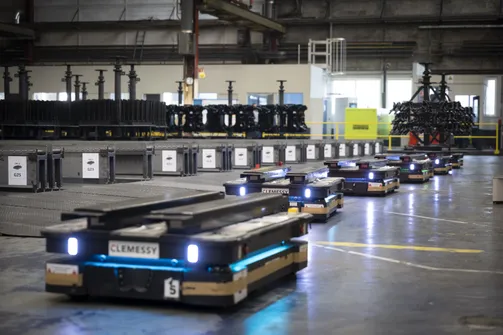
Both AGVs and AMRs move parts, products, and materials automatically, but they differ in how they determine their routes, how they handle obstacles, and how easily they adapt to layout changes.
That said, not every AMR can change its route freely. Some AMRs mainly follow predefined routes, while others generate their path to the destination in real time.
This article explains how AGVs and AMRs work, compares their key differences, outlines the different AMR navigation approaches, identifies the environments each is best suited for, and covers the key factors to evaluate when selecting a solution.
The Key Difference Between AGVs and AMRs
The core difference between AGVs and AMRs is how they determine the path to their destination.
A typical AGV follows a predefined route using magnetic tape, guide wires, 2D codes, or similar markers installed on the floor.
An AMR, by contrast, uses sensors and a map of the facility to determine its current position and navigate to its destination. Because it requires no fixed physical guides, an AMR can easily adapt to new destinations and layout changes.
Put simply, an AGV is "material handling equipment that follows a fixed path," while an AMR is "a mobile robot that navigates to a destination on a map."
However, AMRs also differ in how they navigate. MiR classifies AMRs into two types:
Route-based AMRs, which primarily follow predefined routes
Mission-based AMRs, which generate the path to their destination in real time
MiR AMRs are mission-based: they automatically generate their travel path based on the destination and transport task.
What Is an AGV?
AGV stands for "Automated Guided Vehicle." It is a driverless vehicle that transports materials along a guided path.
AGVs travel automatically along predefined paths using magnetic tape, guide wires, 2D codes, or reflectors. They are well suited to repetitive transport between fixed points, such as between a warehouse and a production line, or between upstream and downstream processes.
The main advantage of AGVs is that their routes and operations are easy to standardize. In facilities where pickup points, drop-off points, and travel routes stay the same over long periods, AGVs move predictably and form a stable transport system.
On the other hand, AGVs that rely on physical guides such as magnetic tape require the guides to be re-laid and routes to be reconfigured whenever equipment or storage locations change. In addition, when an obstacle blocks the path, an AGV typically stops and waits until the obstacle is removed.
What Is an AMR?
AMR stands for "Autonomous Mobile Robot." It is a robot that navigates and transports materials on its own, without fixed guides.
AMRs use sensors such as LiDAR and cameras, together with a map of the facility, to determine their own position and travel to a designated destination.
Because AMRs do not need magnetic tape or guide wires, they can easily accommodate new destinations and layout changes. Some AMRs can also calculate an alternative route to their destination when an obstacle blocks the path, as long as there is enough space to get around it.
For a closer look at AMR sensor configurations, how autonomous navigation works, and real-world use cases, see the following article.
Route-Based AMRs
Route-based AMRs do not use physical guides such as magnetic tape, but they primarily follow routes predefined on a map.
Depending on the product, they may be able to deviate slightly from the set route to avoid obstacles, or choose from several registered routes. However, adding or changing routes may require configuration work by the manufacturer or a system integrator.
Although no physical guides are needed, route-based AMRs operate much like AGVs in practice.
Mission-Based AMRs
With mission-based AMRs, you don't tell the robot which route to take—you tell it what to transport and where.
The robot generates its travel path in real time based on the destination on the map and its surroundings. If it encounters an obstacle or congestion, it recalculates its route as long as an alternative path is available.
MiR AMRs are mission-based, allowing you to define destinations, preferred zones, forbidden zones, and one-way areas on the map. Rather than registering each travel path one by one, you set the rules for your facility, and the robot decides which path to take.
AGV vs. AMR: Comparison Table
Criteria | AGV | Route-Based AMR | Mission-Based AMR |
Primary navigation instruction | Follows a fixed route | Follows routes registered on a map | Travels to a specified destination |
Physical guides | Uses magnetic tape, guide wires, etc. | Generally not required | Not required |
Path generation | Generally none | Selects from registered routes | Generated automatically based on surroundings |
Obstacle handling | Mainly slows down or stops | Stops or performs limited avoidance | Generates an alternative path when conditions allow |
Layout changes | Guides must be relocated or reinstalled | Routes must be reconfigured | Mainly involves updating maps or destinations |
Operational changes | Often requires changes to facility infrastructure | May require specialized configuration | Easy to change in software |
Scaling to multiple vehicles | Requires redesigning routes and traffic control | Depends on system configuration | Easy to scale with fleet management |
Best-fit environment | Facilities with fixed traffic flows and processes | Routine transport where physical guides cannot be installed | Facilities with moving people and equipment, or changing processes |
This table reflects general trends. In practice, some AGVs use lasers or natural features for navigation, and AMRs use a variety of navigation methods.
Rather than judging by product category alone, it is important to evaluate how each system generates paths, handles obstacles, applies configuration changes, and manages multiple vehicles.
AGV vs. AMR: A Detailed Comparison
Navigation and Route Setup
AGVs excel at repeatedly and accurately following predesigned paths.
For example, they are well suited to processes with fixed pickup and drop-off points, such as delivering parts from a warehouse to a production line or collecting finished goods at regular intervals.
With mission-based AMRs, by contrast, you define destinations, drivable areas, forbidden zones, speed-limit zones, and other parameters on the map. When the robot receives a transport task, it automatically calculates the path from its current position to the destination.
MiR AMRs let you create maps, add destinations, and configure missions through a browser-based interface. They can be operated from a PC, tablet, or smartphone, with no dedicated terminal required.
That said, AMRs do not roam a facility without constraints. To ensure stable operation, you may define preferred travel areas, one-way lanes, waiting positions, and intersection priorities.
Obstacle Handling
When a typical AGV detects a person, cart, load, or other object in its path, it slows down or stops to ensure safety.
If it cannot leave its fixed route, it cannot resume transport until the obstacle is removed. Stable AGV operation therefore depends on operating rules such as keeping loads off travel routes and separating vehicle paths from pedestrian walkways.
Mission-based AMRs also prioritize safety by slowing down or stopping when they detect an obstacle. If there is enough space and a viable alternative path, they then recalculate their route and continue to the destination.
MiR AMRs continuously regenerate their path in real time while driving. If people, carts, or equipment block the way, they search for a detour depending on conditions.
However, being an AMR does not guarantee that every obstacle can be avoided. The robot will stop if the aisle is too narrow, if there is no room to detour, or if a person is inside its protective safety field.
When comparing obstacle handling, check the following:
Whether aisles are wide enough for detours
How often people and carts enter the travel route
The height and range of obstacles that can be detected
Conditions under which the robot can automatically resume after stopping
Whether the robot can stop safely with its payload
Adapting to Layout Changes
With AGVs that use magnetic tape or guide wires, changing equipment or storage locations may require relocating or reinstalling the guides.
This is not a major issue in facilities where the equipment layout stays the same for long periods. But in high-mix, low-volume production or cell manufacturing, where processes and equipment are rearranged regularly, every change triggers installation work and test runs.
With AMRs, you can adapt to a new layout simply by changing destinations and travel areas on the map.
With MiR's mission-based AMRs, when production lines or inventory areas are relocated, you can update the map and destinations to adjust operations. Instead of redrawing fixed routes one by one, you change the destination and area settings, and the robot generates new paths.
However, after a layout change, you should re-verify the following:
Whether the required aisle width is maintained
Whether the floor has steps or slopes
Points where robots cross paths with people or forklifts
Charging station locations
Load handover positions and docking accuracy
Wi-Fi and other network connectivity
Although AMRs adapt easily to layout changes, re-validation is still required to confirm safety and transport capacity.
Evaluating Implementation and Operating Costs
You can't compare AGV and AMR costs on vehicle price alone.
AGVs may require installing magnetic tape or guide wires, preparing dedicated travel lanes, and adding load transfer mechanisms at equipment. On the other hand, in facilities where transport routes are fixed and rarely change, AGVs can often run reliably with a simple setup.
AMRs carry sensors and autonomous navigation software, so the robot itself may cost more. However, they minimize the need for fixed guide installation and rarely require major construction when you change layouts or add destinations.
When evaluating options, compare the total cost of ownership (TCO), including the following costs:
Cost category | What to evaluate |
Vehicles and peripherals | Robot, carts, shelves, top modules, charging equipment |
Operating environment | Magnetic tape, guidance infrastructure, floor preparation, network infrastructure |
Deployment and commissioning | Site survey, mapping, route setup, test runs |
System integration | Integration with WMS, MES, ERP, PLCs, conveyors, and automatic doors |
Safety | Risk assessment, speed settings, protective fields, operator training |
Maintenance and operations | Scheduled inspections, consumables, batteries, software updates |
Changes and expansion | Layout changes, new destinations, additional vehicles, re-validation |
Downtime risk | Lost production due to breakdowns, blocked aisles, or network outages |
In addition to its standard top modules, MiR offers MiR Go, a marketplace of ready-made applications for AMRs. It currently lists more than 160 applications and top modules, helping you evaluate configurations for cart towing, shelf transport, pallet transport, conveyor integration, and more.
Using off-the-shelf solutions where possible can reduce the scope of custom engineering. However, actual implementation costs vary depending on the payload, handover equipment, safety measures, and integration with existing systems.
Multi-Robot Operation and Scalability
Whether you use AGVs or AMRs, operating multiple vehicles requires traffic control to prevent them from interfering with one another.
Without proper management of intersection priorities, waiting positions, charging schedules, and mission assignments, adding more vehicles may not deliver a meaningful increase in transport capacity.
With typical AGVs, adding vehicles or destinations may require redesigning travel routes, junctions, and traffic control.
With mission-based AMRs, you can add destinations and transport missions in software. This makes it easy to start with a single process and expand the scope as you validate results.
Managing Multiple Robots with MiR Fleet
MiR AMRs can be centrally managed with MiR Fleet, MiR's fleet management software.
MiR Fleet enables you to:
Receive and prioritize transport missions
Assign the most suitable robot to each task
Coordinate traffic between robots
Monitor battery levels and manage automatic charging
Monitor robot operating status
Integrate with ERP, WMS, and MES via REST API
Standard MiR Fleet can manage up to 100 MiR AMRs. For large-scale operations, MiR Fleet Enterprise supports fleets of more than 100 robots and includes cybersecurity features designed with IEC 62443-4-2 SL-C 3 in mind.
However, adding more AMRs does not increase transport capacity proportionally. Aisles, intersections, load handover equipment, and charging locations can all become bottlenecks, so it is essential to calculate transport volumes and design traffic flows in advance.
Operating Alongside People
When deploying AGVs or AMRs in factories and warehouses where people work, safety must be designed at the level of the entire system—including the travel area—not just the vehicle itself.
With AGVs on fixed routes, it is relatively easy to create a stable operating environment by separating travel paths from pedestrian walkways and installing barriers or signage.
AMRs are designed for environments where people and carts are on the move, and they navigate while monitoring their surroundings with sensors. This makes them a practical option even in existing factories and warehouses where it is difficult to fully separate work areas from transport routes.
Depending on the model, MiR AMRs are equipped with multiple safety laser scanners, 3D cameras, proximity sensors, and other sensors. A safety PLC monitors the sensor data, and the robot slows down or stops when it detects a person, an obstacle, or an internal fault.
In addition, the protective fields adjust dynamically to travel speed: at higher speeds, the robot monitors a wider area and initiates braking earlier.
However, "able to operate in the same space as people" is not the same as "safe under all conditions."
ISO 3691-4:2023 specifies safety requirements for driverless industrial trucks and their systems, including AGVs and AMRs. Deployment requires a risk assessment that covers speed, stopping distance, payload, intersections, human behavior, and surrounding equipment.
Where AGVs Are the Best Fit
AGVs are best suited to facilities with stable transport requirements, where vehicles repeatedly travel fixed routes.
Fixed Pickup and Drop-Off Points
When pickup and drop-off points remain unchanged for long periods—for example, between a warehouse and a production line—AGVs on fixed routes are a natural fit.
Repetitive Transport at a Steady Frequency
In processes that move the same loads to the same locations at a steady frequency, you can take full advantage of the AGV's predictable behavior.
Dedicated Travel Lanes Are Available
If you can provide aisles that are separated from operator and forklift traffic, AGVs are easier to operate reliably.
Infrequent Layout Changes
In facilities where production equipment and storage locations stay the same for long periods, the burden of installing fixed guides is relatively low.
Where AMRs Are the Best Fit
AMRs are best suited to facilities where transport requirements and surroundings change frequently and operations need to stay flexible.
Frequent Movement of People and Carts
In facilities where operators, carts, forklifts, and AGVs are constantly on the move and conditions along the route keep changing, AMRs that perceive their surroundings as they drive are the better fit.
Layouts That Change
In facilities that rearrange equipment or parts storage based on products or processes, AMRs are well suited because they require no fixed guides.
Multiple Destinations
AMRs are well suited to processes where destinations vary by transport task, such as supplying parts to multiple production lines or work areas.
Phased Automation
AMRs also work well when you want to start small—for example, with parts delivery or empty-bin collection for a specific process—and then scale the fleet and scope as you validate results.
Limited Ability to Modify Existing Infrastructure
In operating factories and warehouses, installing magnetic tape or building dedicated lanes may be impractical. Because AMRs require no fixed guides, you can deploy them while making the most of your existing layout.
Key Factors When Choosing Between AGVs and AMRs
When deciding between an AGV and an AMR, evaluate the following factors.
AMR Navigation Method
Don't rely on the "AMR" label alone. Check whether the robot is route-based or mission-based, generating its path according to the destination.
It is also important to understand how the robot behaves when it encounters an obstacle, and who changes routes and how.
Payload Weight, Dimensions, and Packaging
Confirm the weight, dimensions, center of gravity, and packaging of the parts or products to be transported.
The vehicle and top module you need will depend on whether loads are placed on the robot's deck, carts are towed, entire shelves are carried, or pallets are lifted automatically.
Required Throughput
Calculate the required throughput based on the number of transports per hour, travel distance, loading and unloading time, and charging time.
Factor in not only top speed but also waiting time at intersections and handover time with equipment.
Aisles and Operating Environment
Check aisle widths, floor conditions, steps, slopes, doors, elevators, and how often robots will cross paths with people and forklifts.
For an AMR to avoid obstacles, the aisle must be wide enough not only for the robot to pass, but also to detour around obstacles.
Integration with Existing Equipment and Systems
If the robots need to integrate with WMS, MES, ERP, PLCs, conveyors, automatic doors, or elevators, confirm the communication protocols and control methods.
If you plan to automate transport orders in the future, external integration capabilities such as REST API and Modbus TCP should also be part of your selection criteria.
Future Expansion
Even if you start with a single robot, plan ahead for adding more units and expanding to other processes.
Compare the number of robots that can be managed, support for mixed models, traffic control, charging management, and how operational data can be accessed.
Safety Standards and Risk Assessment
Confirm that the product is designed in accordance with the relevant safety standards, and conduct a risk assessment for each site where it will be deployed.
Safety must be evaluated for the entire system—including top modules, payloads, handover equipment, and the operating environment—not just the robot itself.
MiR AMRs for Every Material Handling Application
MiR offers a range of AMRs for every transport application—from small and medium-sized loads to shelves, carts, pallets, and heavy payloads.
By combining them with top modules, you can also support the following transport methods:
Shelf transport with a shelf carrier
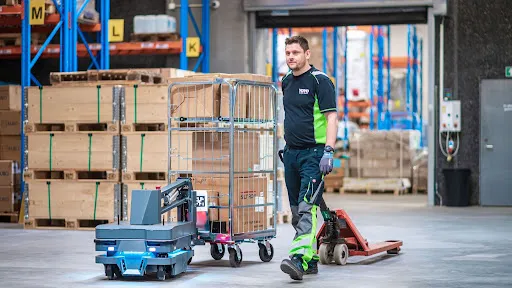
Towing existing carts with a hook
Pallet transport with a pallet lift
Automated transport of shelves and carts with a shelf lift
Load transfer to and from conveyors
Mobile cobots with a collaborative robot mounted on top
MiR250 Hook generates its travel path while accounting for the cart's turning radius, and automatically connects to and tows existing carts. MiR1200 Pallet Jack detects pallets on its own and automates the entire process, from lifting and transporting to delivering them.
When selecting an AMR, it is important to consider not only the robot's payload capacity, but also how loads will be picked up and how they will be handed over at the destination.
Summary
AGVs and AMRs both automate material transport in factories and warehouses, but they differ in how they navigate and the types of operations they handle best.
AGVs may be the right choice for facilities where pickup points, drop-off points, travel routes, and equipment layouts are fixed, and the same transport tasks are repeated reliably.
On the other hand, in facilities with heavy foot and cart traffic, frequent layout changes, or multiple destinations to serve, the flexibility of AMRs offers clear advantages.
AMRs also differ in how they navigate. Beyond the product name, it is important to check whether the robot can generate paths automatically, how it responds to obstacles, and whether on-site staff can change its settings.
MiR offers mission-based AMRs that automatically generate paths based on the destination. By combining products and top modules for a wide range of applications—including parts, carts, shelves, pallets, and heavy loads—you can scale step by step from a single robot to a full fleet.
If you are considering automating in-plant logistics or replacing existing AGVs or manual transport, contact MiR to discuss your payloads, transport volumes, operating environment, and future expansion plans.