How AMRs and Robot Arms Work Together: Mobile Cobots
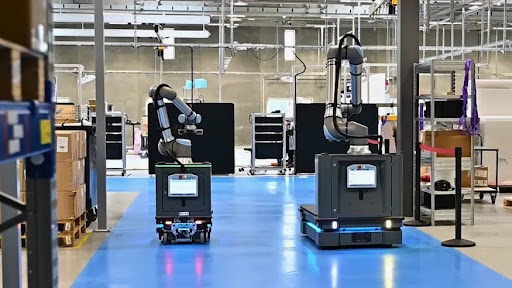 In smart factory automation planning, AMRs, robot arms, and collaborative robot arms (cobots) are often discussed together. However, each serves a different purpose and is suited to different applications and integration approaches. As companies look to further connect intralogistics with process automation, enabling AMRs and robot arms to work together has become an important consideration when implementing automation.
This article begins by explaining the respective roles of autonomous mobile robots and robot arms, then explores Mobile Cobot applications, MiR solutions, and the integration of positioning, Fleet, and MES systems. It also covers real-world use cases and frequently asked questions to help companies evaluate the automation architecture best suited to their needs.
What Roles Do AMRs and Robot Arms Play?
If we think of factory automation in terms of human movement, an AMR is like the “legs,” responsible for moving from point A to point B, while a robot arm is like the “hands,” responsible for picking, placing, and performing tasks once it reaches the destination. A true Mobile Cobot combines these two capabilities into a system that can move and perform tasks autonomously.
Simply put, an autonomous mobile robot (AMR) handles “movement,” while a robot arm handles “operation.” The former can autonomously transport materials between warehouses, production lines, and workstations, while the latter excels at precision tasks such as picking, machine tending, assembly, and inspection.
AMRs: Mobility and Material Transport
The primary role of an autonomous mobile robot (AMR) is to navigate autonomously, plan routes, and transport materials or equipment to designated locations. Using facility maps, sensor data, and assigned tasks, an AMR can move autonomously between warehouses, production lines, and different workstations. This makes it particularly suitable for frequent, repetitive intralogistics tasks across multiple areas. It can also serve as a mobile base for transporting a robot arm between workstations.
The value of MiR AMRs extends beyond the mobile platform itself. Top Modules, material transfer methods, and software integration can further expand their range of applications to meet different facility and process requirements.
Related reading: How AMRs Enable Warehouse Automation and Material Handling
Robot Arms: Picking and Process Operations
The strengths of collaborative robot arms go beyond precise picking and positioning. They also offer high flexibility and are easy to deploy and reconfigure. Compared with large, fixed automation equipment, cobots are more compact and require less floor space, making them easier to integrate into existing production lines.
Their intuitive software also makes it easier to reprogram the robot and adjust its tasks. This makes cobots particularly suitable for high-mix, low-volume production, frequent changeovers, and manufacturing environments where processes change regularly.
Combining the Two: From “Transporting to a Workstation” to “Performing Tasks Upon Arrival”
If an AMR only transports materials to a workstation, operators may still need to pick up materials, load or unload equipment, or perform other tasks at the starting point and destination, creating manual gaps in an otherwise automated workflow.
By adding a collaborative robot arm, the system can further connect material picking, transportation, on-site operations, and subsequent delivery. This enables previously separate logistics and production processes to form a more continuous automated workflow.
What Is a Mobile Cobot, and How Is It Different from a Collaborative Robot?
A Mobile Cobot integrates a collaborative robot (cobot) with an AMR, transforming a fixed robot arm into an autonomous mobile manipulation platform. A conventional cobot is typically installed at a fixed workstation, where it performs tasks such as CNC machine tending, screwdriving, or assembly over extended periods. A Mobile Cobot, by contrast, can travel autonomously to different workstations and perform tasks based on production needs.
This makes Mobile Cobots particularly suitable for smart factory environments with high-mix, low-volume production, frequent changeovers, or regularly changing equipment and task requirements.
Related reading: AGV vs. AMR for Electronics Manufacturing
What Tasks Can an AMR and Robot Arm Perform Together?
Material Picking, Placement, and Transport
Autonomous mobile robots (AMRs) are well suited for transporting bins, racks, or carts across different areas. However, if manual loading and unloading are still required at the starting point and destination, human intervention remains a gap in the automated workflow. A Mobile Cobot can use its collaborative robot arm to pick up and place materials, while the AMR handles movement between different areas or workstations, connecting previously separate loading, unloading, and transportation processes into a more integrated workflow.
CNC Machine Tending and Equipment Loading and Unloading
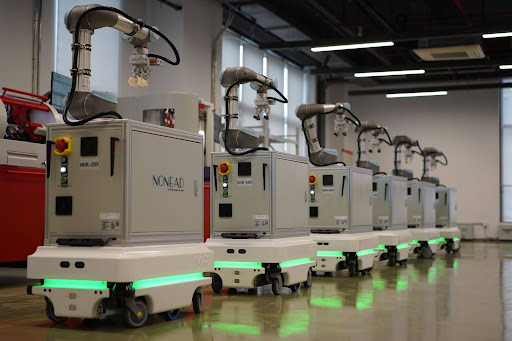
Machine tending is one of the most representative Mobile Cobot applications. The cobot can pick and place workpieces and load or unload equipment, while the AMR moves to the next workstation. For example, SGIMRI integrated a MiR AMR with a UR10 collaborative robot arm for CNC machine tending, allowing material movement and machine operation to be completed within the same automated workflow.
Related reading: MiR AMRs Help SGIMRI Unlock the Efficiency Potential of Intralogistics
Production Across Multiple Workstations
Many products need to move through multiple processes in sequence, such as machining, cleaning, inspection, assembly, or packaging. A Mobile Cobot can transport workpieces through the production process and perform the required operation after arriving at each workstation, making it easier to connect previously separate processes.
For smart factories and AI factories with high-mix, low-volume production, frequently changing layouts, or a need for greater equipment scheduling flexibility, Mobile Cobots can also reduce the constraints that fixed automation places on production line configurations.
Quality Samples and Inspection Workflows
In quality inspection workflows, AMRs and collaborative robot arms can divide tasks such as sample picking and placement, transportation between stations, and loading and unloading inspection equipment. The robot arm can retrieve samples for inspection from production equipment, racks, or designated locations, while the AMR transports them to measuring equipment, laboratories, or quality inspection stations. Upon arrival, the robot arm can load the samples into the inspection equipment, retrieve them after inspection, and transport them to the next station according to the defined workflow.
This approach can reduce the need for quality control personnel to repeatedly collect and transport samples between different areas while enabling samples to follow a consistent workflow between production, measurement, and inspection stations. For factories moving toward smart inspection, it can also improve workflow continuity and increase the level of automation throughout the inspection process.
Recommended MiR AMR Mobile Robot Arm Solutions
MC250 and MC600: Ideal for Machine Tending and Flexible Multi-Station Operations
The MC250 and MC600 are Mobile Cobot solutions available through the MiR Go ecosystem. They are compatible with the MiR250 and MiR600, respectively, combining the autonomous mobility of an AMR with robot arm operation on a single platform. They can be used for repetitive machine loading and unloading, material handling, production line delivery, and replenishment tasks.
Both solutions use a block-based drag-and-drop interface for task configuration and scheduling. They also support marker calibration and 2D object recognition, with optional AI-powered 3D object detection and pose estimation to provide greater flexibility in positioning and pick-and-place operations across different workstations.
Read the product overviews: MC250 and MC600
MiR1350: Ideal for Large, Heavy Loads and High-Payload Logistics
The MiR1350 offers a payload capacity of up to 1,350 kg and is designed for automating heavy-load and pallet transportation. It can be used for the intralogistics transport of large goods, pallets, and heavy materials.
With an IP52 rating and 13 TÜV-certified safety functions, the MiR1350 is designed to operate in demanding industrial environments while supporting extended, high-payload logistics operations.
Read the product overview: MiR1350
How Can a Mobile Cobot Create a Fully Automated Production Line?
1. The AMR First Transports the Robot Arm to the Designated Workstation
The process begins with an autonomous mobile robot (AMR) navigating through the facility and transporting the complete Mobile Cobot system to a designated CNC machine, rack, or production workstation. Unlike a robot arm fixed at a single workstation, a Mobile Cobot can move to different locations based on task requirements, where the robot arm can then perform picking and placing, material replenishment, or machine loading and unloading.
In MiR applications for the electronics industry, MiR + Universal Robots is also presented as a Mobile Cobot configuration for tasks such as CNC machine tending, C-parts Kanban, and consumables and material replenishment. This allows the robot arm to expand its automation coverage with the AMR rather than remaining permanently stationed beside a single machine.
2. Precise Docking and Coordinate Calibration Upon Arrival
When a Mobile Cobot arrives at a workstation, the robot arm is not necessarily ready to pick up a workpiece immediately. In addition to the AMR’s own positioning, the system may require docking position calibration and object recognition at the workstation.
Depending on the application, markers, vision systems, or other workstation calibration methods can be used to establish a stable relative position between the robot arm and the workpiece.
3. MES and Fleet Coordinate Tasks and Equipment
As the number of Mobile Cobots and tasks increases, the system must address questions such as which task should be performed first, which robot should perform it, and whether a particular area is currently accessible. The MiR architecture can scale from individual robot operation to Fleet Management and integrate with higher-level systems such as ERP, WMS, and MES through REST APIs. MiR Fleet centrally manages AMR missions, traffic, and charging while selecting an appropriate robot from the fleet to perform each task.
In other words, MiR Fleet primarily manages the AMR fleet. When an MES detects that a CNC machining cycle has been completed, the higher-level integration architecture can generate a task, and Fleet can then assign an appropriate AMR to travel to the workstation. Once it arrives, the PLC, robot arm controller, or other equipment control system can take over the actual production process.
Related reading: MiR Fleet
4. The Mobile Cobot Performs the Task and Reports the Result
After Docking and coordinate calibration are complete, the robot arm begins performing actual operations such as picking, placing, machine tending, inspection, or other tasks. When integrated with MiR Fleet and enterprise systems such as ERP, MES, and WMS, the system can report equipment status, task completion signals, or exception information back to the higher-level system once the work is complete. The AMR then proceeds to the next workstation.
The overall workflow can form a cross-station automation architecture: “Higher-level system generates a request → Fleet assigns an AMR → Mobile Cobot travels to the workstation → Docking and position calibration → Robot arm performs the task → Task status is reported → Mobile Cobot proceeds to the next workstation.” This allows the AMR to serve not only as material handling equipment, but also as part of a more complete smart factory automation process together with cobots, workstations, and enterprise systems.
Related reading: How to Choose an AMR: A Complete Guide to Payload, Specifications, Operating Environment, and Implementation
)
MiR AMR and Collaborative Robot Arm Implementation Cases
MiR Mobile Cobot Case Study 1: SGIMRI Integrates an AMR with a UR10 for CNC Machine Tending
 Business Challenge
The Sino-German Intelligent Manufacturing Research Institute (SGIMRI) aimed to build a more flexible, customized production chain by reducing reliance on fixed tracks and rigid connections between workstations, while also supporting small-batch, high-mix production and training demonstrations. Because CNC machine tending requires a high degree of positioning stability from the mobile system, and personnel frequently move through the demonstration and training centers, equipment flexibility, system integration capabilities, and safe human-robot collaboration were all important considerations when implementing automation.
MiR AMR Implementation
The AMRs also use multiple sensors and path-planning capabilities to perceive their surroundings and avoid people and obstacles, while open interfaces enable connection and communication with other equipment.
Results
By combining MiR AMRs with UR robot arms, SGIMRI transformed machine tending and material handling processes that were previously fixed to individual workstations into a more flexible form of mobile automation. This enabled more adaptable production line configurations and more diverse processing routes, while allowing the same equipment to support different work locations and task requirements.
The AMRs can also autonomously adjust their routes in dynamic environments where people and forklifts are present, improving the overall system’s adaptability and level of automation integration.
Related reading: How MiR AMRs and Cobots Connect Machine Tending Across Workstations to Support Flexible Production at SGIMRI
FAQ: Common Questions About AMR and Cobot Integration
When Is a Mobile Cobot Suitable?
A Mobile Cobot is particularly suitable for automated processes that require both movement between workstations and task execution upon arrival. It also provides greater deployment flexibility in high-mix, low-volume environments with frequent changeovers, regularly changing production line layouts, or applications where the same robot arm needs to support multiple workstations.
If the requirement is limited to fixed point-to-point material transport from A to B, an AMR with an appropriate Top Module may be sufficient. If a robot arm only needs to perform a fixed task at a single workstation over the long term, a stationary cobot can be considered first.
Is AMR Navigation Accuracy Sufficient for CNC Machine Tending?
When evaluating whether a Mobile Cobot is suitable for CNC machine tending, both the AMR’s positioning at the workstation and the overall positioning method required for cobot operation should be considered, rather than relying solely on the AMR’s navigation accuracy. The AMR must first reach the designated workstation. Before the cobot can perform precise CNC loading and unloading, additional methods such as docking, marker calibration, and vision-based recognition may be required to ensure accurate pick-and-place operations.
Can an AMR Be Integrated with Existing Cobots or Production Lines?
Yes. Existing equipment does not necessarily need to be completely replaced, but integration should be planned according to the interfaces of on-site equipment, material transfer methods, and the existing automation architecture. Depending on the application, companies can evaluate how to connect AMRs with cobots, conveyors, production cells, or higher-level systems.
How Should the Safety of AMRs and Cobots Be Evaluated?
Even if the AMR and collaborative robot (cobot) each have their own safety functions, a risk assessment of the complete application is still required once they are integrated into a Mobile Cobot system. In addition to the AMR and cobot themselves, docking, workstation layout, personnel movement, and the actual operating environment should all be taken into consideration.
Every mobile robot deployment requires a risk assessment. In addition to using AMRs that comply with applicable safety standards, system integrators and end users must also conduct safety assessments based on the actual application.
Why Do Many Companies Choose the Combination of MiR and Universal Robots?
MiR and Universal Robots are both part of Teradyne Robotics, allowing the mobility capabilities of AMRs to be combined with the picking, machine tending, and process operations of cobots to create a more complete Mobile Cobot automation architecture. MiR Fleet also provides an open REST API that can integrate with higher-level systems such as ERP, MES, and WMS.
Combined with the flexible mobility of Mobile Cobots, this setup can accommodate production line changeovers, workstation adjustments, and future expansion requirements, while both MiR and Universal Robots are designed with collaboration and safety in mind.
Conclusion: Connecting Material Transport and Process Automation with Mobile Cobots
Mobile Cobots connect the autonomous material transport capabilities of AMRs with the process automation capabilities of cobots, bringing material movement, pick-and-place operations, and multi-station tasks into a more integrated workflow. At the same time, they give smart factories and AI factories the flexibility to adjust tasks and reconfigure production lines as manufacturing requirements change.
Before implementing automation, companies should first identify the bottlenecks that have the greatest impact on production capacity, labor requirements, and process efficiency. They can then determine whether an AMR, cobot, or Mobile Cobot best fits their actual needs, ensuring that automation addresses real operational challenges rather than simply adding more equipment.
Related reading: 10 Common Logistics Bottlenecks in Electronics Manufacturing: How Can AMRs Improve Line-Side Supply and Material Handling?
This article was translated from Traditional Chinese.
)
)
)