AMR Selection Guide: Payload, Specs & Implementation
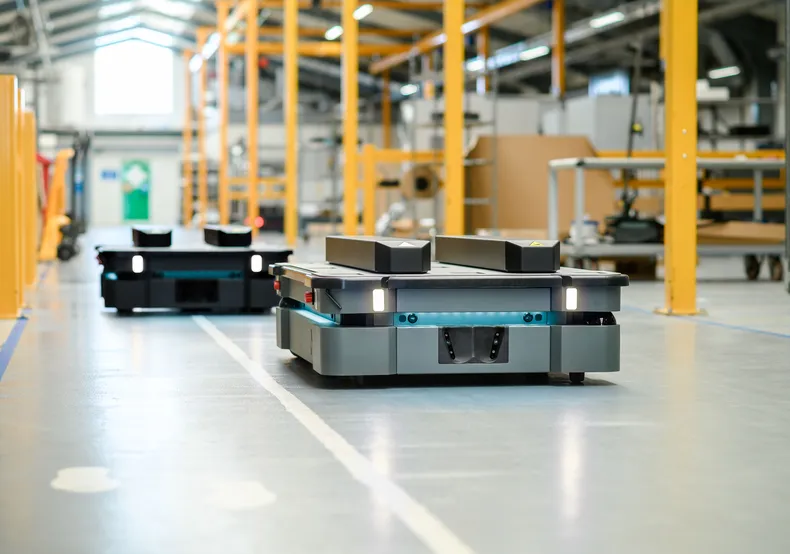
When implementing MiR autonomous mobile robots (AMRs), one of the first questions many companies ask is, “What specifications should we choose?” Rather than immediately comparing maximum payloads and speeds in a specification sheet, it is more important to first identify which logistics process or operational requirement needs to be addressed. By working backward from these requirements to determine the appropriate robot platform, Top Modules, software, and number of robots, companies can identify an automation solution that truly fits their operating environment. To select the right AMR for your facility, start by evaluating the following nine key factors.
Related reading: 10 Common Logistics Bottlenecks in Electronics Manufacturing: How AMRs Improve Line-Side Supply and Material Handling
How to Choose an AMR: 9 Key Selection Criteria to Evaluate Before Implementation
1. Automation Goals: Why Do You Need an AMR?
The first step is not deciding which AMR to buy, but identifying why automation is needed. Companies may want to address labor shortages in logistics, reduce repetitive cart pushing and material handling, improve working conditions, or reduce waiting time. They may also need a more flexible logistics model than fixed conveyor systems or traditional automated guided vehicles (AGVs) because production lines are frequently reconfigured. Different automation goals will affect subsequent equipment configurations, budgets, integration requirements, and expected benefits.
2. Materials to Be Transported: What Are You Moving, and How Heavy or Large Is It?
AMR payload capacity is only the first specification to consider. Companies also need to determine the typical and maximum weight of the materials, their dimensions, packaging methods, and the carriers currently in use. Bins, KLT containers, carts, mobile racks, pallets, and large components can all affect the selection of the robot platform and Top Module.
It is also necessary to determine whether materials will be loaded and unloaded manually, transferred automatically, or handed off between the AMR and conveyors, automated storage systems, or production equipment.
3. Operating Environment: Where Will the AMR Operate?
Site conditions can often become a greater constraint than the AMR’s own specifications. The evaluation should include aisle widths, corners, doors, elevators, low-clearance areas, floor conditions, and whether the AMR will share routes with people, carts, forklifts, AGVs, or other mobile equipment.
Aisles and corners should not be evaluated based solely on the dimensions of the robot itself. The complete dimensions of the Top Module and actual load must also be considered to ensure sufficient space for travel and passing.
4. Industry Requirements: Are There Special Environmental or Safety Requirements?
Special environmental and safety requirements directly affect whether an AMR can operate in a facility and which equipment specifications or versions are required. For example, electronics manufacturing environments may require ESD protection to prevent electrostatic discharge during transport from affecting sensitive components.
AMRs also typically exchange tasks and data through Wi-Fi, Fleet Management, or enterprise systems, making IT security another important consideration when planning an implementation.
5. Expected Outcomes: What Benefits Do You Want the AMR to Deliver?
Before implementing AMRs, companies should define the outcomes they want to improve, such as reducing transport waiting time, decreasing manual material handling hours, increasing task completion rates, or supporting additional shifts. Once clear KPIs have been established, companies can determine how many AMRs are required, what operating capabilities are needed, and whether the investment aligns with the expected ROI and TCO.
6. Employee Interaction: Are Employees Ready to Work with AMRs?
Introducing AMRs will change existing material handling responsibilities and workflows, so whether employees understand and accept the new processes can also affect implementation results. Before selecting a solution, companies can assess employees’ familiarity with robots, whether there are concerns about job security, and who will be responsible for day-to-day management and system operation. Actual users should also be involved early in the planning and training process, with clear responsibilities and operating permissions established.
7. System Integration: What Level of Automation Is Required?
Not every AMR project needs to integrate with ERP, WMS, or MES systems from the beginning. Simple applications can start with a small number of robots operating on fixed routes, with tasks assigned through tablets, user interfaces, or material request mechanisms. As the number of AMRs and tasks increases, Fleet Management can be introduced to centrally manage tasks, traffic, and charging.
If the goal is to establish fully automated logistics, APIs can be used to enable enterprise systems such as ERP, WMS, and MES to generate transport tasks directly.
8. Process Compatibility: Does the AMR Need to Integrate with Other Automation Equipment?
AMRs are primarily responsible for “material movement.” However, if material pickup, unloading, or handoff to production equipment still requires manual intervention, gaps may remain in the automated workflow. Depending on the transport method and operational requirements, AMRs can be combined with Conveyors, Shelf Carriers, Pallet Lifts, Hooks, or Cobots to connect with production lines, racks, carts, or pallet handling processes and further reduce manual intervention.
9. Service and Support: Who Will Be Responsible for Maintenance and Expansion?
Responsibilities for ongoing maintenance and expansion should be defined before AMR implementation. Daily operation, basic troubleshooting, and internal management can be handled by company personnel, while more complex repairs, software upgrades, parts replacement, and future fleet expansion can be supported by MiR and its integration partners.
Establishing clear service and management processes in advance can also make it easier to add more MiR AMRs or expand deployment to other facilities in the future.
Which Autonomous Mobile Robot Should You Choose: AMR vs. AGV?
When planning intralogistics automation, AMRs and automated guided vehicles (AGVs) are often compared. However, the right choice should not be based solely on the type of equipment or a single specification. Companies also need to consider their material handling processes, operating environment, and future expansion requirements. Using traditional fixed-guidance AGVs as the basis for comparison, the following section examines four key areas: navigation methods, obstacle handling, implementation flexibility, and suitable applications.
AMR vs. AGV Comparison Table
Comparison | AMR (Autonomous Mobile Robot) | AGV (Automated Guided Vehicle) |
|---|---|---|
Navigation | Uses maps, laser scanners, sensors, and software for autonomous localization and route planning without relying on fixed tracks | Typically follows magnetic strips, guide wires, reflective markers, or predefined routes |
Obstacle Handling | Can detect its surroundings and slow down, stop, or replan an available route depending on conditions | Traditional fixed-guidance AGVs typically stop and wait when an obstacle blocks their path |
Implementation Flexibility | When production lines, stations, or tasks change, maps and tasks can be reconfigured with relatively little need for fixed infrastructure | Operates reliably on highly fixed routes, but route changes typically require corresponding modifications to the guidance infrastructure |
Suitable Applications | Logistics processes involving multiple production lines, frequently changing routes, shared spaces with people and vehicles, multiple stations, or future expansion | Material handling processes with long-term fixed, highly repetitive routes that rarely change |
Related reading: AGV vs. AMR for Electronics Manufacturing
Why Should Companies Choose MiR AMRs?
For companies evaluating autonomous mobile robots (AMRs), material handling efficiency is only one consideration. It is equally important to determine whether the platform can provide reliable operation, safe navigation, and long-term scalability. MiR offers a complete range of AMR solutions that support different payload requirements, with a Fleet Management system for centrally coordinating multiple robots.
MiR can also integrate with enterprise systems such as ERP, MES, and WMS, helping companies incorporate AMRs into their existing production and logistics processes. From a single material transport route to automated logistics deployments across multiple facilities, the system can be expanded gradually based on operational requirements, reducing implementation risks and ongoing management costs.
Which MiR AMR Should You Choose? Find the Right Model by Payload, Material, and Application
MiR250: Small and Medium-Sized Logistics up to 250 kg
If your facility primarily transports bins, parts, carts, or small racks, the MiR250 can serve as a platform for small and medium-sized logistics automation. Its relatively agile design makes it suitable for environments with closely spaced stations, limited space, or frequently changing production layouts. Different Top Modules can also be added based on the material handling method to support rack, cart, and material delivery applications.
Read the MiR250 product overview
MiR600: Heavy-Duty Logistics up to 600 kg
When material handling requirements extend from standard bins to larger materials or pallets, the MiR600 can be considered. Its 600 kg payload capacity supports heavier intralogistics applications. When equipped with modules such as a Pallet Lift, it can support pallet pickup, transport, and unloading processes in production areas, warehouses, and other heavy-load material handling applications.
Read the MiR600 product overview
MiR1350: Large, Heavy Loads and High-Payload Logistics
For large components, heavy carriers, or high-payload pallets, the MiR1350 can handle loads of up to 1,350 kg, making it suitable for heavy-duty logistics between raw material areas, production lines, and warehouses. Because the loads are larger and heavier, implementation planning should also verify that aisle widths, turning radii, floor conditions, and station space meet actual operating requirements.
Read the MiR1350 product overview
MiR1200 Pallet Jack: High-Volume Pallet Transport
If a company wants to automate the complete pallet pickup, transport, and placement process rather than simply carrying pallets on an AMR, the MiR1200 Pallet Jack is better suited to this type of requirement. It can perform pallet detection, pickup, transport, and placement directly, making it suitable for logistics processes with frequent pallet movements where companies want to reduce the use of manually operated forklifts or manual handoffs. Pallet specifications, pickup and drop-off locations, and route space should still be verified during planning.
How to Implement an AMR
Step 1: Assess Requirements
Once the implementation phase begins, the first step is to convert the previously identified selection requirements into verifiable process data. Start by mapping the complete material flow from the starting point through pickup, transport, and unloading. Record the current Cycle Time, waiting time, and manual labor involved to establish a pre-implementation Baseline, then select a suitable process to prioritize for automation as the target for a Demo or POC.
Step 2: Estimate the Number of AMRs
After completing the requirements assessment, an initial estimate of the required number of AMRs can be made based on task volume and the complete Cycle Time. The calculation should include travel to the pickup point, loading, transport, unloading, the return trip or travel to the next task, and any necessary waiting time.
For example, if 20 tasks must be completed per hour during peak periods and each task takes an average of 6 minutes, approximately 120 minutes of AMR operating time are required per hour. The theoretical minimum would therefore be two AMRs. However, this is only an initial estimate. Charging, traffic delays, task distribution, and site conditions should also be validated and adjusted during the POC stage.
Step 3: Evaluate the Site and Systems
Once the requirements have been confirmed, the next step is to verify whether the solution can be implemented in the actual operating environment. This includes determining whether the AMR can travel smoothly along the planned routes, whether pickup and drop-off can be completed at each station, and whether network, system, and equipment signals can be properly integrated.
An application-level Risk Assessment should also be conducted to confirm that safety requirements are still met when the load, Top Module, pedestrian traffic, and interactions with other equipment are taken into account.
Step 4: Demo and POC
After completing the requirements and site assessments, a Demo can first be arranged to observe the AMR operating in the actual environment, including turns, aisles, obstacles, interactions with people, and docking conditions. A representative process can then be selected for a POC to test localization, obstacle avoidance, Cycle Time, docking success rate, human interaction, and system integration.
The purpose of the POC is not simply to demonstrate that the “AMR can move,” but to verify whether the complete process can operate reliably in the actual environment.
Step 5: Full Deployment and Fleet Expansion
Once the POC meets the predefined KPIs, full deployment can begin. The routes, tasks, and operating methods tested during the POC can be incorporated into daily operations, while procedures for exception handling, maintenance, access permissions, and training are established.
After a single process is operating reliably, additional AMRs, stations, or applications can be added gradually based on task volume, avoiding overly rapid expansion that could increase management complexity.
Related reading: How Can AMRs Automate Warehousing and Material Handling? A Complete Guide to Smart Intralogistics Applications
FAQ: Common Questions About AMR Selection and Implementation
Is a Higher AMR Payload Always Better?
Not necessarily. A higher payload capacity typically also affects the robot’s size, overall loaded dimensions, turning space, speed, energy consumption, and total cost. If the materials being transported on a regular basis weigh only 100 to 200 kg, selecting a large heavy-duty AMR may not deliver greater efficiency and could make narrow aisles and station design more challenging. A more appropriate approach is to first determine the typical and maximum payloads, then evaluate them together with the material dimensions, Top Module, pickup and drop-off methods, and operating environment.
Is a POC Always Required Before Selecting an AMR?
Not every project requires a POC of the same scale, but the more complex the operating environment, the greater the value of on-site validation. Projects involving mixed traffic with people and vehicles, narrow aisles, special floor conditions, multiple floors, or integration with ERP, MES, WMS, and automation equipment are well suited to using a Demo or POC to validate navigation, Cycle Time, and equipment handoffs. If the application is highly standardized and the operating environment is simple, the scope of validation can be adjusted according to the project requirements.
Does an AMR Deployment Always Require a Fleet Management System?
If there is only one AMR and the tasks are simple with fixed routes, it may not be necessary to implement a complex Fleet Management system from the beginning. As the number of autonomous mobile robots increases, task allocation, traffic, charging, station occupancy, and priorities begin to affect one another, increasing the value of centralized fleet management. When companies want to integrate with ERP, WMS, or MES systems, APIs can also be used to connect task dispatching with higher-level systems.
Can AMR Tasks or Production Lines Be Changed After Deployment?
Yes. This is one of the important characteristics of AMRs compared with traditional fixed logistics equipment. When the facility layout, stations, or tasks change, the system can be reconfigured through maps, Missions, and system settings. However, being “reconfigurable” does not mean there are no physical limitations. If a new task involves heavier or larger loads, the existing AMR’s payload capacity, dimensions, and Top Module may no longer be suitable. If a station is changed to use automated Conveyor handoffs, additional mechanical and signal integration will also be required.
Conclusion: Start AMR Selection with Process Requirements, Not Specification Sheets
There is no single best AMR specification. The key is whether the AMR can meet a company’s actual material handling requirements and operating conditions. After completing the requirements and site assessments, companies can determine the appropriate MiR AMR, Top Module, and integration method. For a first implementation, companies can start with clearly defined processes that are easy to validate, then gradually expand the scope of automation once the results have been confirmed. This approach can reduce the burden of manual material handling while improving logistics efficiency and overall process flexibility.
Related reading: How Do AMRs Work with Robot Arms and Cobots? A Complete Guide to Applications and Integration
This article was translated from the original Traditional Chinese version.
)
)
)