How AMRs Enable Warehouse Automation and Material Handling
)
From raw material receiving, warehousing, material preparation, and production line replenishment to the transfer of quality control samples, medical supplies, and finished goods across different areas, every stage of operations depends on a reliable flow of materials. As material types, delivery frequency, and operational complexity increase, businesses need more flexible and scalable material handling solutions.
This article explores how autonomous mobile robots (AMRs) are used in electronics manufacturing and healthcare environments for component delivery, sample and supply transport, pallet handling, and warehouse automation. It also examines how MiR integrates different material handling modules and systems to build scalable automated warehouse systems and smart intralogistics solutions.
How Can AMR-Powered Intralogistics Improve Business Competitiveness?
The goal of intralogistics and warehouse automation is not simply to move goods faster, but to minimize disruptions to production caused by material handling, waiting times, and material buildup. When employees frequently leave their workstations to transport materials, quality control samples must wait for manual collection and delivery, or pallets of finished goods accumulate at the end of production lines, these activities can increase non-value-added labor hours and reduce efficiency between production stages.
Autonomous mobile robots (AMRs) have emerged as essential tools for warehouse automation and smart intralogistics in response to these challenges. AMRs can navigate between warehouses, production lines, and workstations based on assigned tasks. By integrating shelving, carts, conveyor modules, pallet handling equipment, and fleet management systems, businesses can gradually transform fragmented material handling tasks into streamlined, automated warehouse workflows.
Component Inbound and Outbound Handling and Production Line Delivery
AMRs can transport components, pallets, and work-in-progress (WIP) between warehouses, material preparation areas, and production lines based on fixed schedules, on-demand material requests, or system-assigned tasks. This helps align material supply with actual production cycles. During SKU changes or production line changeovers, AMRs can deliver materials for the next production batch while retrieving unused materials from the previous batch, reducing changeover time.
A single AMR fleet can also support multiple production lines, adjusting delivery contents and routes to meet different task requirements. This allows AMR logistics capabilities to scale more easily as production volumes, product mixes, and production line configurations change. For manufacturers, the key benefits include more reliable material flow, improved throughput efficiency, and greater flexibility for future capacity expansion or production layout adjustments.
Quality Control Sample and Medical Specimen Transport
In electronics manufacturing, food processing, pharmaceuticals, and healthcare environments, quality control samples and medical specimens often need to be transported continuously between different operational areas and laboratories.
AMRs can transport samples to quality inspection areas, storage facilities, or laboratories based on assigned tasks. When automated loading and unloading are required, AMRs can also be integrated with collaborative robotic arms.
By establishing consistent and reliable transport workflows, AMRs support quality control processes and sample logistics while allowing personnel to focus on testing, analysis, and result interpretation.
End-of-Line Pallet Transport
MiR AMRs can integrate directly with automated palletizing equipment at the end of production lines. Once palletizing is complete, AMRs can automatically pick up, transport, and unload pallets, delivering finished goods to temporary storage areas or finished goods warehouses. This creates a continuous automated logistics workflow connecting production, palletizing, and warehousing.
For example, the MiR600 and MiR1350, when equipped with pallet lift modules, can autonomously perform pallet pickup, transport, and unloading. Beyond improving pallet handling efficiency, this approach also reduces the dependency between production line layouts and fixed logistics routes.
AMRs can integrate with existing palletizers, while tasks and routes can be reconfigured through software. Compared with solutions that rely heavily on fixed conveyor systems or floor-based guidance infrastructure, AMRs offer greater flexibility when adjusting production lines, adding stations, or changing material flow directions.
Further Reading: What Is an AMR? AMR vs. AGV: Key Differences, Features, and Real-World Applications
Why Do Traditional Material Handling Processes Create Bottlenecks?
Traditional material handling relies heavily on manual labor, carts, forklifts, and fixed conveyor systems. However, as the number of production lines and SKUs increases and delivery frequency rises, previously effective workflows can gradually develop bottlenecks in material transport and lead to longer waiting times.
Manual Material Handling: High Flexibility but Heavy Reliance on Labor
When employees must repeatedly perform the same material handling tasks, their time and expertise can be consumed by transportation rather than higher-value activities. MiR's material handling comparison also highlights that manual transport may require employees responsible for high-value tasks to leave their workstations during peak production periods simply to maintain material flow.
Therefore, AMRs are better suited to taking over routine, predictable, and repetitive material handling tasks rather than automating all manual operations indiscriminately.
Forklifts: Suitable for Heavy Loads but Require Mixed-Traffic Management
In facilities where employees, carts, forklifts, and other equipment operate simultaneously, businesses must devote greater attention to managing traffic intersections, right-of-way, and movement routes.
Rather than replacing forklifts entirely, a more practical approach is to assign routine, predictable horizontal transport tasks to AMRs or autonomous pallet handling equipment while retaining forklifts for high-level storage and retrieval and specialized loading and unloading operations.
Fixed-Guidance AGVs: Suitable for Stable, Highly Repetitive Transport Routes
Traditional fixed-guidance automated guided vehicles (AGVs) typically follow predefined paths using magnetic strips, guide wires, or other guidance technologies. This makes them suitable for material handling operations where workstations and transport routes remain stable over extended periods.
However, frequent changes to production line locations, workstations, or transport routes may require reprogramming or modifications to the supporting infrastructure.
In contrast, autonomous mobile robots (AMRs) use sensors, maps, and software to navigate independently. When they encounter obstacles that can be bypassed, they can dynamically replan their routes, making them more adaptable to changes in material flow and facility layouts.
What Is the Difference Between Logistics, Transportation, Warehousing, and Intralogistics?
When planning to implement autonomous mobile robots (AMRs), businesses often encounter terms such as logistics, transportation, warehousing, and intralogistics. Although all four involve the movement of materials, they differ in scope and operational applications. These distinctions directly influence where and how automation equipment should be deployed.
Before evaluating AMR solutions, businesses can clarify the role of each concept through the following four areas:
Logistics: Encompasses the coordination of goods movement, warehousing, inventory management, and order fulfillment, including the planning and coordination of the overall supply chain.
Transportation: Refers to the physical movement of goods from one location to another and represents a specific operational activity within the broader logistics process.
Warehousing: Focuses on goods storage, inventory management, order processing, and material handling within warehouses before distribution.
Intralogistics: Manages material movement and the coordination of operations between different areas within warehouses, factories, and distribution centers.
When implementing AMRs, the goal is not simply to automate transportation. Instead, businesses should reassess how materials move between warehousing, production, and shipping operations to identify the material handling processes best suited for automation.
How Are AMRs Used in Warehouse Automation?
In automated warehouses, AMRs primarily handle material transport between different operational areas. This includes moving incoming materials from receiving areas to storage or processing zones, delivering bins and carts to workstations, and transporting processed goods to the next stage of the logistics workflow.
Inbound Material Transport from Receiving to Storage Areas
After trucks are unloaded, raw materials, returnable containers, and pallets typically need to be transported from the receiving area to temporary storage areas, inspection zones, or designated storage locations. Although this process may seem straightforward, it can require employees or forklifts to make frequent trips over long distances.
AMRs can automate routine, repetitive tasks with clearly defined pickup and delivery points. For example, they can transport incoming materials to designated processing areas or, in cross-docking operations, route different goods directly to repackaging, storage, or shipping areas.
This allows employees to focus on receiving verification, quality inspections, and exception handling.
Transporting Bins, Shelving Units, and Carts
In automated warehouses, bins, small components, tools, and other small to medium-sized materials can be placed on fixed shelving units mounted on AMRs. The AMRs then transport these materials between different logistics points.
Employees only need to load materials at the pickup point and unload them at the destination, automating tasks that would otherwise require repeated trips.
For facilities that already rely heavily on carts, trolleys, or roll cages, AMRs can work with existing transport equipment. They can autonomously identify, engage, and transport these carriers to designated locations, reducing the need for employees to push or pull loads over long distances and perform repetitive material handling tasks.
Existing carts of different heights can also be incorporated into automated material handling workflows based on the specific requirements of each facility.
Automated Pallet Handling
When fixed pallet racks or pickup and drop-off stations are installed at the starting and ending points of a workflow, AMRs equipped with lift modules can automatically transfer pallets to and from these stations.
For operations that require direct handling of pallets placed on the floor, AMRs equipped with forks and pallet recognition capabilities can autonomously detect, engage, lift, and place pallets.
This enables businesses to transform repetitive horizontal pallet transport tasks, traditionally performed by employees or forklifts, into continuous automated logistics operations.
Further Reading: How Do AMRs Collaborate with Robotic Arms and Cobots? Applications and Integration Explained
Which MiR AMR Is Right for Different Material Handling Tasks?
Bins and Components: MiR250 with Fixed Shelving and Conveyor Integration
The MiR250 features a compact design and high maneuverability, with dimensions of approximately 580 × 800 mm and a maximum payload capacity of 250 kg. It can navigate through aisles as narrow as 80 cm, making it suitable for AMR logistics applications involving small to medium-sized materials.
Its compact footprint makes it well suited for facilities with densely packed equipment or operations that require frequent movement between workstations. Depending on the materials and load carriers used, the MiR250 can be equipped with different top modules to support the transport of components, bins, carts, and shelving units.
Actual aisle and doorway width requirements should be evaluated based on load dimensions, top modules, and safety configurations.
Learn More: MiR250 Product Overview
Existing Carts: MiR250 with Hook and Shelf Carrier Modules
The MiR250 can be equipped with the MiR250 Hook or MiR Shelf Carrier 250 to support a wider range of cart and shelving transport applications.
The MiR250 Hook uses AprilTags to identify carts of different heights and autonomously pick up, tow, and deliver them. It can tow loads of up to 500 kg, and existing carts typically require only the addition of identification markers to be compatible.
The MiR Shelf Carrier 250 can automatically pick up and drop off shelving units, material racks, and carts, with a maximum load capacity of 300 kg. It is suitable for intralogistics operations that require frequent carrier changes, deliveries between workstations, or multi-stop pickup and delivery tasks.
Learn More: MiR250 | MiR250 Hook | MiR Shelf Carrier 250
Shelving Units and Heavy Materials: MiR600 and MiR1350
The MiR600 and MiR1350 are designed for medium-to-heavy payloads and heavy material handling, with maximum payload capacities of 600 kg and 1,350 kg, respectively. They are suitable for the automated transport of pallets, large components, and heavy materials between warehouses and production lines.
Both models offer enhanced durability and an IP52 protection rating, supporting frequent, long-duration intralogistics operations. The MiR1350 is particularly suitable for extra-heavy loads and high-payload applications.
Learn More: MiR600 | MiR1350 | MiR Shelf Lift 1350
Pallet Logistics: MiR600, MiR1350 with Pallet Lift, or MiR1200 Pallet Jack
The MiR1200 Pallet Jack and MiR Pallet Lift 1350 are both designed for automated pallet handling.
The MiR1200 Pallet Jack can autonomously detect, pick up, and transport pallets weighing up to 1,200 kg. Its AI-powered perception system enhances pallet recognition and pickup and drop-off efficiency.
The MiR Pallet Lift 1350, when integrated with the MiR1350, enables autonomous pallet lifting, pickup, transport, and unloading, with a maximum payload capacity of 1,250 kg. It is suitable for high-frequency, repetitive heavy-duty pallet handling operations.
Learn More: MiR600 | MiR1350 | MiR1200 Pallet Jack | MiR Pallet Lift 1350
How Can AMRs Scale into a Fully Automated Warehouse System?
Building a truly automated warehouse requires more than simply purchasing an autonomous mobile robot. It involves gradually connecting task generation, material handoffs, multi-robot fleet coordination, and operational feedback into an integrated workflow.
MiR's deployment guide therefore recommends a "Think Big, Start Small" approach: begin with a clearly defined process where the return on investment (ROI) can be more easily validated, then gradually increase the complexity of system integration.
Reference: Mobile Robot Deployment Guide
Automated Material Handoffs with Conveyors and Workstations
Initial AMR deployment can begin with a single workflow, such as warehouse-to-production-line delivery, quality control sample transport, or the transfer of semi-finished goods between workstations. Once the workflow is stable, additional workstations, automated warehouse areas, and production lines can be gradually incorporated.
To further reduce manual loading and unloading, AMRs can be equipped with top modules that enable automated material transfers with conveyor systems, shelving units, and other equipment. This transforms AMRs from standalone transport solutions into integrated logistics nodes capable of automated material handoffs.
Scaling from a Single AMR to a Fleet with Fleet Management
As material handling workflows, workstations, and robot numbers increase, businesses need to move beyond managing individual tasks toward coordinating multiple AMRs.
A fleet management system can centrally coordinate task assignments, fleet traffic, and charging schedules. Instead of having each AMR perform a fixed set of tasks independently, multiple robots can work together to serve different logistics points based on actual operational requirements.
MiR's AMR selection guidelines also categorize automation into three levels: standalone robot operation, fleet management, and fully automated workflows integrated with enterprise resource planning (ERP), warehouse management systems (WMS), and manufacturing execution systems (MES).
Measuring Logistics Automation Performance with KPIs and Scaling Deployment
The effectiveness of warehouse automation should not be measured solely by how many kilometers an AMR travels each day. Instead, businesses should evaluate whether automation has addressed the original logistics challenges.
After AMRs are deployed, the first step toward scaling should be to assess whether existing workflows and equipment are being utilized effectively, rather than simply adding more robots.
Fleet sizing should account for travel distances, task volumes, and the number of robots required. Starting with a proof of concept (POC) is recommended, followed by gradual deployment expansion based on actual operating conditions.
For ongoing operations, MiR Insights can be used to monitor fleet performance through metrics such as completed tasks, travel distances, robot utilization rates, and high-traffic areas.
Further Reading: How to Choose an AMR: A Complete Guide to Payload Capacity, Specifications, Applications, and Deployment
MiR Case Studies: How AMRs Improve Warehouse Automation and Material Handling
MiR Case Study 1: How Kimball Electronics Improved Production Efficiency with AMRs
Business Challenges
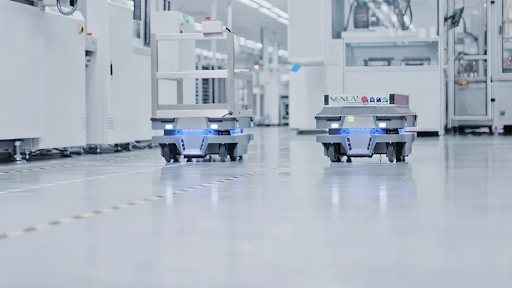
Kimball Electronics' Nanjing facility faced challenges related to complex production processes, raw material supply, and heavy reliance on manual labor. The company sought a more flexible, easy-to-deploy intralogistics solution capable of handling multiple tasks simultaneously.
MiR AMR Implementation
In 2021, the facility deployed two MiR250 autonomous mobile robots to transport products, raw materials, and bins between different production stations.
One MiR250 transports carts from the end of the production line to loading equipment. The other performs multiple material delivery tasks, including transporting products from the end of the production line back to the beginning, delivering materials for surface-mount technology (SMT) processes, and moving printed circuit boards (PCBs) from the warehouse to the laser marking station.
Implementation Results
To manage multiple tasks, Kimball Electronics also implemented MiR Fleet to centrally coordinate AMR charging and scheduling.
According to the official case study, the two MiR250 robots support continuous, 24-hour operations. Kimball Electronics also reported that each MiR250 can handle a workload equivalent to that of two employees, allowing personnel to be reassigned to other production tasks.
Read the Full Case Study: How Kimball Electronics Achieved Continuous 24-Hour Operations
MiR Case Study 2: How Flexcon Implemented MiR250 for Automated Warehouse Logistics
Business Challenges
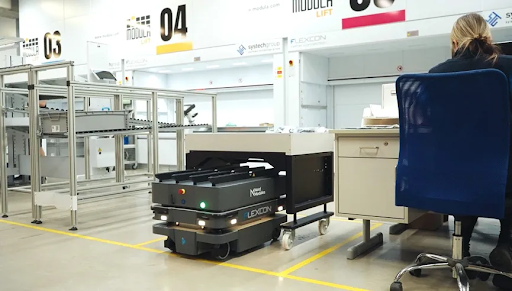
Flexcon is a family-owned manufacturing company in the Czech Republic that specializes in wire harnesses and electromechanical assemblies. As its product range expanded, materials were stored across multiple floors and locations, resulting in longer picking and retrieval times, increased manual handling workloads, and a greater risk of errors.
Flexcon sought to accelerate material delivery to its production lines without increasing its workforce while establishing a scalable intralogistics infrastructure to support future production growth.
MiR AMR Implementation
Flexcon deployed multiple MiR250 autonomous mobile robots and integrated them with Modula vertical lift modules (VLMs), MiR Fleet, and its enterprise resource planning (ERP) and warehouse management system (WMS).
Materials are stored in KLT containers within the Modula system and tracked using QR codes. When the ERP system issues a material request, a transport task is automatically generated. The system can retrieve the correct tray from the VLM before the MiR250 arrives.
Once the materials are retrieved, the MiR250 delivers them to the production line and returns the tray to the storage area, creating an automated workflow that connects warehousing, material picking, and production line replenishment.
Implementation Results
By integrating AMRs, automated storage equipment, and software systems, Flexcon can automatically transport materials across three floors, reducing manual material retrieval, data entry, and waiting times.
The system currently handles approximately 1,000 items per shift. With the integration of scanning, monitoring, and Put-to-Light systems, the error rate has fallen below 0.5%.
The solution also reduces labor requirements for picking and material handling while improving overall intralogistics efficiency and the reliability of material supply.
Read the Full Case Study: How Flexcon Reduced Its Error Rate to Below 0.5% with MiR250
FAQ: Common Questions About AMR Warehouse Automation and Logistics
This FAQ addresses common questions about MiR AMR deployment, including facility suitability, equipment roles, system integration, and fleet sizing. It helps businesses assess their operational requirements before implementing automated warehouse systems and material handling automation.
Are AMRs Suitable for Every Warehouse and Factory?
Not necessarily. Determining whether autonomous mobile robots (AMRs) are suitable for a facility requires evaluating several factors, including load weight and dimensions, aisle widths and turning space, floor conditions, pedestrian and vehicle traffic, transport frequency, and material handoff methods.
During the initial project planning stage, businesses should assess transport distances, hourly component volumes, aisle requirements for two-way traffic, Wi-Fi connectivity, and external system integration requirements before selecting the appropriate AMR models and fleet size.
Can AMRs Completely Replace Forklifts?
Not necessarily. AMRs can take over certain high-frequency, repetitive pallet handling and internal transport tasks, but different types of equipment remain suited to different operations.
For example, ICM uses AMRs to transport pallets from the receiving area to the ends of aisles in its high-bay warehouse, while manually operated material handling equipment handles high-level storage and retrieval.
When implementing AMRs, businesses should determine how autonomous mobile robots and forklifts can complement each other based on load weight, pickup and drop-off methods, storage height, and logistics routes.
How Many AMRs Are Needed to Automate Material Handling?
There is no fixed formula that determines the number of AMRs required based solely on warehouse floor area.
Fleet sizing should consider transport distances, task volumes, logistics requirements, routes, and facility conditions rather than relying only on warehouse size or individual robot payload capacity.
Businesses can begin with a small-scale proof of concept (POC) to validate actual operating performance, then adjust the number of AMRs based on task volumes and future warehouse automation requirements.
Can AMRs Use Elevators to Transport Materials Between Floors?
Yes, but this requires integration between the AMR system and the elevator. Not all AMR brands support direct elevator integration.
MiR Fleet Enterprise supports integration with industrial elevators and multi-floor navigation. Therefore, businesses planning automated warehouse systems that involve transportation between floors should evaluate elevator integration, inter-floor routes, and relevant facility conditions during the project planning stage.
Do AMRs Need to Integrate with WMS, MES, or ERP Systems?
Not necessarily. AMRs can initially perform simple tasks, such as following predefined routes or responding to operator-initiated transport requests, without requiring immediate integration with enterprise resource planning (ERP), warehouse management systems (WMS), or manufacturing execution systems (MES).
As automation scales and task complexity increases, MiR Fleet can be introduced to centrally manage multiple AMRs.
For more advanced warehouse automation workflows, AMRs can also be integrated with external systems such as ERP, WMS, and MES through REST APIs. These higher-level systems can generate transport tasks, which MiR Fleet then assigns to the appropriate autonomous mobile robots for execution.
Conclusion: Building More Flexible Warehouse Automation and Intralogistics with AMRs
The value of autonomous mobile robots (AMRs) lies in their ability to support different material handling requirements through shelving units, Hook, Shelf Carrier, Conveyor, and Pallet Lift modules. With MiR Fleet, businesses can centrally coordinate task assignments, traffic management, and charging schedules across multiple robots.
As AMR logistics operations expand, integration with warehouse management systems (WMS), manufacturing execution systems (MES), and enterprise resource planning (ERP) systems enables transport tasks to be automatically triggered by actual orders and production status.
When planning smart intralogistics, businesses should therefore begin by identifying their operational requirements rather than immediately selecting a specific AMR model. Key considerations include what materials need to be transported, their pickup and delivery locations, daily transport frequency, and how loading and unloading will be handled.
Once these workflows are clearly defined, businesses can select the appropriate AMRs, top modules, and level of system integration to build a scalable automated warehouse system that supports long-term operational growth.
This article was translated from Traditional Chinese.
)
)
)